
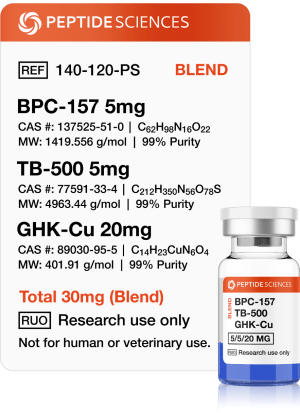
BPC-157, TB-500, GHK-Cu 30mg (Glow Blend)
165,00 $
Peptide Sciences BPC-157 from EU Peptide Sciences — a 15-amino-acid sequence derived from a protective protein found in gastric juice. From $165.
- BPC-157 — synthetic pentadecapeptide, supplied for laboratory research only
- Identity and purity confirmed by third-party HPLC and mass spectrometry
- Certificate of analysis on request from support@eupeptidesciences.com
- Quantity supplied: 30mg
- Lyophilised powder in a sealed vial, stable under frozen storage
- Worldwide discreet, tracked shipping — free express on orders of $250 or more
- Cryptocurrency payments receive 5% off
Description
This listing covers Peptide Sciences BPC-157: a synthetic pentadecapeptide held in EU stock and dispatched to institutional buyers.
BPC-157 is notable for its stability in aqueous solution relative to many short peptides. BPC-157 itself is a 15-amino-acid sequence derived from a protective protein found in gastric juice.
Peptide Sciences BPC-157 online
BPC-157, TB-500, GHK-Cu (Glow Blend) 30mg is listed at $165, supplied as a lyophilised vial. That works out at $5.50 per mg of compound.
Orders are processed once payment is confirmed. Payment is handled manually: after you place an order our team emails payment instructions to the address on the order, and paying in cryptocurrency takes 5% off. The minimum order is $100, standard delivery takes 7–14 business days and express 3–7, and orders of $250 or more ship express free. If your payment instructions have not arrived, write to support@eupeptidesciences.com with your order number.
Peptide Sciences BPC-157 — the presentation, the price and the supporting documentation are all on this page.
Cryptocurrency payment takes 5% off an order that includes Peptide Sciences BPC-157, as it does for the rest of the range.
Compound profile: BPC-157, TB-500, GHK-Cu (Glow Blend)
BPC-157, TB-500, GHK-Cu (Glow Blend) is a 15-amino-acid sequence derived from a protective protein found in gastric juice.
It also appears in the literature as Body Protection Compound 157, PL 14736.
This listing is a blend. It combines 3 research compounds in one presentation, and each is a separate line of published work:
- BPC-157 is a fifteen-residue gastric-derived peptide studied for angiogenesis and tendon-fibroblast migration.
- TB-500 is a synthetic fragment covering the actin-binding region of Thymosin Beta-4, studied for cell migration and wound closure.
- GHK-Cu is the copper(II) complex of the tripeptide Gly-His-Lys, studied for extracellular-matrix remodelling and antioxidant gene expression.
BPC-157 is notable for its stability in aqueous solution relative to many short peptides. It is supplied as a lyophilised vial, which keeps it stable in transit and simple to log into inventory.
BPC-157, TB-500, GHK-Cu (Glow Blend) is part of the EU Peptide Sciences and peptide science range, which lists 187 research compounds across 18 categories, each released against third-party analysis. Compare peptide sciences peptides, peptide sciences lab testing, and the peptide sciences website notes before you order.
For Peptide Sciences BPC-157, orders ship worldwide to eligible destinations in plain packaging with tracking.
For Peptide Sciences BPC-157, the certificate of analysis for the batch in stock can be requested by email before ordering.
BPC-157, TB-500, GHK-Cu (Glow Blend) research applications
BPC-157 is a fifteen-residue fragment of a larger gastric protein. Reported mechanisms include upregulation of VEGFR2, interaction with the nitric-oxide system, and modulation of growth-hormone-receptor expression in tendon fibroblasts.
Published work on BPC-157, TB-500, GHK-Cu (Glow Blend) sits in the research literature, always in vitro or in animal models. The main areas are:
- Angiogenesis and capillary formation in tissue models
- Tendon and ligament fibroblast migration assays
- Gastrointestinal mucosal integrity research
- VEGFR2 signalling and nitric-oxide pathways
- Growth-factor expression during tissue repair
- Vascular endothelial protection loops
Tendon fibroblast migration, endothelial tube formation and gastric mucosal injury models are the three most common systems in the literature.
Tendon and ligament fibroblast migration assays appears in the literature as a measurable question, and BPC-157, TB-500, GHK-Cu (Glow Blend) is used there because its structure is known and reproducible between batches.
Protocols covering gastrointestinal mucosal integrity research tend to run BPC-157, TB-500, GHK-Cu (Glow Blend) across a concentration range so that any relationship between exposure and readout can be described rather than assumed.
The page for Peptide Sciences BPC-157 also covers storage, handling and the certificate of analysis, so nothing has to be requested twice.
Anyone searching for Peptide Sciences BPC-157 will find the price, presentation and batch documentation set out on this page.
BPC-157, TB-500, GHK-Cu (Glow Blend) specification table
| Property | Detail |
|---|---|
| Compound | BPC-157, TB-500, GHK-Cu (Glow Blend) |
| Classification | Synthetic fragment |
| Quantity supplied | 30mg |
| Presentation | Lyophilised powder in a sealed vial |
| Purity | Verified by third-party HPLC and mass spectrometry |
| Intended use | Laboratory research use only |
Fields that are not listed for BPC-157, TB-500, GHK-Cu (Glow Blend) are not stated on the batch record, rather than omitted for brevity.
Researchers comparing options for Peptide Sciences BPC-157 will find the neighbouring compounds linked below.
This page answers the query “Peptide Sciences BPC-157”: what the compound is, how it is supplied and how to order it.
Receiving, storing and preparing BPC-157, TB-500, GHK-Cu (Glow Blend)
Unlike many short peptides, BPC-157 is reported to be stable in gastric-type acidic solution, which is why oral-formulation studies exist. It is nonetheless best stored lyophilised and frozen.
Keep the sealed vial in a freezer at -20 °C, protected from light. Lyophilised material is stable for extended periods under those conditions.
After reconstitution, refrigerate at 2–8 °C, use a bacteriostatic diluent where repeated withdrawal is planned, and avoid repeated freeze-thaw cycles. The full routine is set out in the peptide storage guide.
Stock-concentration arithmetic for a 30mg vial of BPC-157, TB-500, GHK-Cu (Glow Blend): dissolved in 1 mL of diluent it gives 30 mg/mL, in 2 mL it gives 15 mg/mL, and in 5 mL it gives 6 mg/mL. Fixing the diluent volume before the vial is opened means every experiment in a study starts from the same stock.
Questions about Peptide Sciences BPC-157 are answered by email, and the order ships once payment is confirmed.
BPC-157, TB-500, GHK-Cu (Glow Blend) against neighbouring compounds
It is most often studied next to tb-500 (thymosin beta-4), and the two are supplied together in several blends; for a copper-peptide comparison see ghk-cu 50mg.
Other presentations of BPC-157, TB-500, GHK-Cu (Glow Blend) in the catalogue: bpc-157, tb-500, ghk-cu (glow blend). Presentations differ in quantity and price per vial, not in the compound.
BPC-157, TB-500, GHK-Cu (Glow Blend) is catalogued under glow peptides, and the whole range is listed under research peptides for sale.
Peptide Sciences BPC-157 is listed for laboratory research only, and orders are accepted on that basis.
How each batch is verified
Analysis is carried out by a third-party laboratory rather than in-house, and the resulting certificate is tied to a specific batch reference that appears on your vial label.
Requesting documentation is straightforward: quote the batch reference and the certificate of analysis follows by email. Request a certificate at support@eupeptidesciences.com, and see how to read a peptide certificate of analysis for what to check on it.
A first order for Peptide Sciences BPC-157 must meet the $100 minimum, which applies to the whole basket.
Questions researchers ask about BPC-157, TB-500, GHK-Cu (Glow Blend)
Why is BPC-157 called a body protection compound?
The name comes from its origin as a fragment of a protective protein found in gastric juice. It is a research designation rather than a description of any effect.
What does the 157 refer to?
It is the catalogue number of the fragment within the original research series, not a length or a molecular weight.
Is BPC-157, TB-500, GHK-Cu (Glow Blend) for human use?
No. BPC-157, TB-500, GHK-Cu (Glow Blend) is supplied strictly as a research chemical for laboratory work. It is not a medicine, not a supplement and must not be administered to humans or animals.
Can I see a certificate of analysis for BPC-157, TB-500, GHK-Cu (Glow Blend)?
Yes. Email support@eupeptidesciences.com with the compound or the batch reference on your label and the certificate covering that batch will be sent to you.
How should BPC-157, TB-500, GHK-Cu (Glow Blend) be stored?
Keep the sealed vial in a freezer at -20 °C, protected from light. Lyophilised material is stable for extended periods under those conditions. After reconstitution, refrigerate at 2–8 °C, use a bacteriostatic diluent where repeated withdrawal is planned, and avoid repeated freeze-thaw cycles.
What is the minimum order and how long does delivery take?
The minimum order value is $100. Standard delivery takes 7–14 business days and express 3–7 business days, with rates shown at checkout. Orders of $250 or more ship express free, in discreet packaging with tracking.
Research use only. Supplied for controlled laboratory research. The compound is not approved for therapeutic use and must be handled by qualified personnel only.

Reviews
There are no reviews yet.